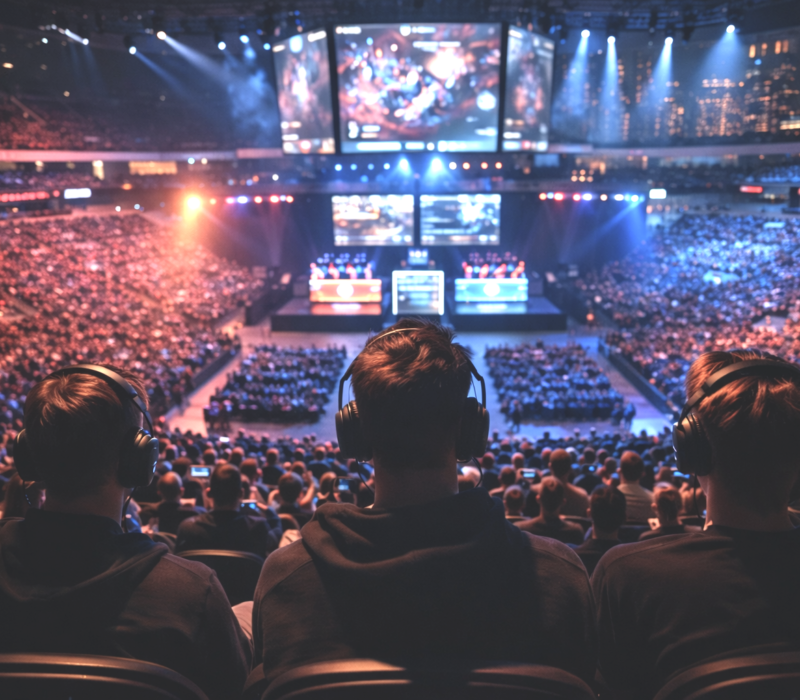
A rapidly expanding global market
Esports has experienced extraordinary growth over the past decade. Industry reports estimate that global esports revenues now exceed $1.5 billion annually, with projections indicating continued expansion as sponsorship, media rights and advertising revenue streams mature. Audience growth has been equally dramatic. Global esports viewership is estimated to surpass 600 million viewers, driven largely by younger demographics and digital-native consumption habits. Unlike traditional sports broadcasting models, esports relies heavily on online streaming platforms such as Twitch, YouTube and regional streaming services.
Revenue streams within esports are diverse and continue to evolve, key sources include:
· sponsorship and advertising agreements
· media and streaming rights
· tournament prize pools
· game publisher support and developer fees
· merchandise and team branding
Sponsorship remains the largest revenue contributor, with both endemic brands (gaming hardware, technology companies) and non-endemic brands (automotive, financial services and consumer goods companies) increasingly entering the space.
Investment by traditional sports owners
Traditional sports franchises and investors have played a major role in legitimising the esports sector. Owners of major sports teams across the NFL, NBA, Premier League and European football leagues have invested heavily in esports organisations and league structures.
For example:
· NBA teams invested in the NBA 2K League
· football clubs such as Paris Saint-Germain, Manchester City and Schalke 04 have created esports divisions
· private equity and venture capital firms have increasingly funded esports teams and tournament organisers
These investments reflect growing recognition that esports appeals to younger audiences who may consume entertainment differently from traditional sports fans. For sports franchises seeking long-term relevance and diversification, esports represents a strategic entry point into digital competition and entertainment markets.
The regulatory framework
With growing investment and commercialisation, regulators and policymakers are paying greater attention to the esports industry. Issues attracting scrutiny include:
· gambling and betting on esports competitions
· integrity concerns such as match-fixing and cheating
· player welfare and employment protections
· intellectual property rights relating to game publishers
Governments and regulatory bodies are beginning to consider whether esports should be regulated similarly to traditional sports. However, the absence of a unified governing body complicates attempts to implement consistent regulatory frameworks.
Lack of unified regulation
One of the defining features of esports is the absence of a centralised global governing authority. Traditional sports typically operate under well-established governing structures that provide regulatory oversight and dispute resolution.
For example:
· FIFA governs international football
· UEFA regulates European football competitions
· the International Olympic Committee (IOC) oversees the Olympic Games
These organisations establish rules, enforce disciplinary frameworks, regulate transfers and administer competition structures. In contrast, esports governance is fragmented. Each game title operates effectively as its own ecosystem, governed primarily by the publisher that owns the intellectual property rights to the game, such as Riot Games with titles such as League of Legends or Valorant. This means there is no equivalent to FIFA or IOC for esports as a whole.
The role of publishers
Game publishers occupy a unique and powerful position in the esports ecosystem. Because they own the intellectual property rights to the games, they ultimately control whether competitive tournaments may take place and how they are structured. Publishers may operate their own leagues, license tournament organisers, establish rules governing competitive play and control broadcasting and streaming rights.
Examples include:
· Riot Games, which operates the League of Legends Championship Series (LCS)
· Activision Blizzard, which created the franchised Overwatch League
· Valve, which allows third-party tournament organisers for games like Counter-Strike and Dota 2
This publisher-driven model differs fundamentally from traditional sports, where no entity owns the underlying sport itself.
Comparison with traditional sports governance
Traditional sports governance typically features a hierarchical structure consisting of international federations (e.g. FIFA), continental bodies (e.g. UEFA), national associations
And leagues and clubs. This layered governance structure enables consistent rules, disciplinary systems and dispute resolution mechanisms across jurisdictions. Esports lacks such institutional cohesion. Instead, the industry operates through a patchwork of:
· publisher-controlled leagues
· independent tournament organisers
· team organisations
· streaming platforms
While several organisations have attempted to create overarching governance frameworks such as the Esports Integrity Commission (ESIC), their authority remains limited and voluntary.
Legal Issues emerging in Esports
As esports matures into a sophisticated commercial industry, a wide range of legal issues have begun to emerge. These issues often mirror those found in traditional sports but are complicated by the digital nature of the industry and the dominant role of publishers.
Player contracts
Professional esports players increasingly sign employment or service agreements with teams and organisations. However, contractual practices in the industry remain inconsistent.
Common contractual issues include:
· unclear employment status (employee vs independent contractor)
· restrictive buyout clauses
· exclusivity and streaming obligations
· prize pool distribution
Young players who are often teenagers may sign agreements without fully understanding their rights or negotiating leverage. This has led to disputes over contract enforceability and allegations of exploitative terms. Some jurisdictions have begun introducing regulatory frameworks to protect esports players. For example, France introduced a new bill for legislation requiring esports player contracts to meet certain employment standards.
Sponsorship disputes
Sponsorship agreements form a significant part of esports revenues. However, disputes can arise where sponsors clash with existing publisher relationships or league regulations.
Issues frequently include:
· conflicts between team sponsors and league sponsors
· exclusivity provisions restricting competing brand partnerships
· reputational risks associated with controversial sponsors
Because many esports competitions are controlled by publishers, teams may face restrictions that would be unusual in traditional sports sponsorship arrangements.
Intellectual property ownership
Intellectual property is central to esports because the underlying games are proprietary software owned by publishers. Unlike football or basketball, each esports title is protected by copyright and licensing agreements. This creates several legal implications:
· publishers may revoke licenses for tournaments
· teams and tournament organisers depend on publisher approval
· broadcasting rights may be tightly controlled by the developer
Publishers therefore possess a level of control that has no equivalent in traditional sports governance.
Streaming and media rights
Streaming platforms have played a critical role in the growth of esports. Rights to broadcast tournaments can be highly valuable, particularly for major international events.
Legal disputes may arise regarding:
· exclusivity agreements with streaming platforms
· unauthorised broadcasts
· monetisation of gameplay content
Because players and streamers often broadcast gameplay independently, determining ownership and licensing rights for streamed content can be legally complex.
Dispute Resolution in Esports
Arbitration in traditional sports
Dispute resolution in traditional sports is heavily influenced by arbitration mechanisms designed to ensure efficient and specialised adjudication. The Court of Arbitration for
Sport (CAS) in Lausanne is the most prominent example. CAS hears disputes involving player transfers. disciplinary sanctions, anti-doping violations and contractual disputes.
CAS arbitration offers several advantages:
· specialised expertise in sports law
· faster resolution compared with national courts
· international enforceability under arbitration frameworks
As a result, many sports federations require disputes to be resolved through CAS arbitration.
The current landscape in esports
In esports, dispute resolution mechanisms are far less standardised. Disputes are typically resolved through:
· private arbitration clauses in player contracts
· publisher-controlled disciplinary processes
· national court litigation
The absence of a universal regulatory framework means there is no single forum for resolving esports disputes across the industry. Some publishers operate internal dispute mechanisms for leagues they control (such as the Riot Games dispute resolution process), however, this only limits the dispute resolution mechanism to a few game titles owned by the publisher, and to parties that have specifically included that method of resolving a dispute in their contract.
Potential future role of CAS
As esports becomes more institutionalised, there has been increasing discussion about whether CAS could eventually play a role in resolving esports disputes. Several factors could support such a development:
· growing overlap between esports and traditional sports organisations
· increasing investment by established sports institutions
· the need for neutral international dispute resolution mechanisms
However, significant challenges remain. CAS jurisdiction typically depends on the presence of sports governing bodies that recognise its authority. Because esports lacks a unified governing structure, establishing CAS jurisdiction would require industry-wide cooperation. Nevertheless, as esports governance evolves, arbitration frameworks modelled on traditional sports may become increasingly attractive.
Key risks for investors
Regulatory uncertainty
Investors entering the esports sector must navigate a regulatory environment that remains fluid and uncertain. The lack of centralised governance means regulatory standards vary across jurisdictions and across game titles.
Regulatory developments could affect:
· player employment regulations
· gambling and betting laws
· broadcasting rights
· intellectual property licensing
Monitoring these developments is essential for investors seeking long-term stability in esports investments.
Contractual risk
Contracts play a particularly significant role in esports due to the absence of standardised regulatory frameworks. Investors should carefully assess:
· player contract enforceability
· league participation agreements
· sponsorship restrictions
· intellectual property licensing terms with publishers
Poorly drafted agreements may expose organisations to substantial financial and reputational risk.
Cross-border jurisdiction issues
Esports competitions are inherently international. Teams, players, tournament organisers and sponsors often operate across multiple jurisdictions. This creates complex legal challenges relating to:
· governing law clauses
· enforcement of arbitration awards
· employment law compliance
· taxation of prize winnings and sponsorship revenue
Establishing clear dispute resolution mechanisms and jurisdiction clauses is therefore essential when structuring esports investments and agreements.
Conclusive thoughts
Esports has developed into a global entertainment industry attracting significant capital, audiences and commercial partnerships. However, the sector’s governance structure remains fundamentally different from traditional sports, creating unique legal and regulatory challenges. The dominant role of game publishers, combined with fragmented governance frameworks, means that many legal issues from player contracts to intellectual property rights require careful navigation.
As the industry continues to mature, greater regulatory oversight and more standardised dispute resolution mechanisms are likely to emerge. Arbitration frameworks similar to those used in traditional sports may play an increasing role in resolving esports disputes.
For investors, teams and stakeholders entering the esports ecosystem, understanding the legal landscape will be critical to managing risk and capitalising on the industry’s continued growth.